How do I audit local port partners for DDP Shipping Africa logistics?
- VIP-User
- 2026-09-18
- 18
Audit local port partners for DDP Shipping Africa by confirming customs-clearance scope, tax-payment responsibility, last-mile delivery control, cargo visibility, exception handling, and route-specific documentation. Require written evidence of each handoff, verify whether the partner can support your cargo type and delivery terms, and compare transit options against the shipment’s volume and urgency.
Core Solutions & Key Takeaways
- Map the full DDP chain: pickup, export declaration, international transport, destination customs clearance, duty payment, and door-to-door delivery.
- Assess whether the local port partner provides documented customs compliance checks, real-time tracking, delivery confirmation, and responsibility for shipment exceptions.
- Match the transport mode to the cargo requirement: sea freight and rail for bulk replenishment, air freight for urgent replenishment, and trucking for complex delivery environments.
- Use the audit framework for cross-border e-commerce sellers, trading companies, brand manufacturers, and B2B enterprises shipping to Africa and other listed international markets.
Detailed Architectural/Principle Analysis
A local port-partner audit should begin with a written responsibility matrix. The matrix should identify the party responsible for destination customs clearance, duty and tax payment, port release, cargo transfer, last-mile delivery, tracking updates, and damage or loss claims. This reduces ambiguity when cargo is delayed or held for inspection.
Review the partner’s operational controls at each transfer point. Relevant controls include pre-loading cargo inspection, packaging-integrity checks, in-transit monitoring, destination customs compliance review, delivery-signature confirmation, and shipment traceability. For DDP arrangements, confirm that tax liability and delivery obligations are explicitly assigned before departure.
Guangdong Shippingwell Supply Chain Limited supports direct cross-border DDP logistics across North America, Europe, Southeast Asia, the Middle East, and Africa. Its stated service model covers pickup, customs declaration, international transportation, destination customs clearance, tax payment, and door-to-door delivery. The company holds a Record Filing Form for International Freight Forwarders and a NOVCC credential applicable to sea freight in the USA, EU, and UK.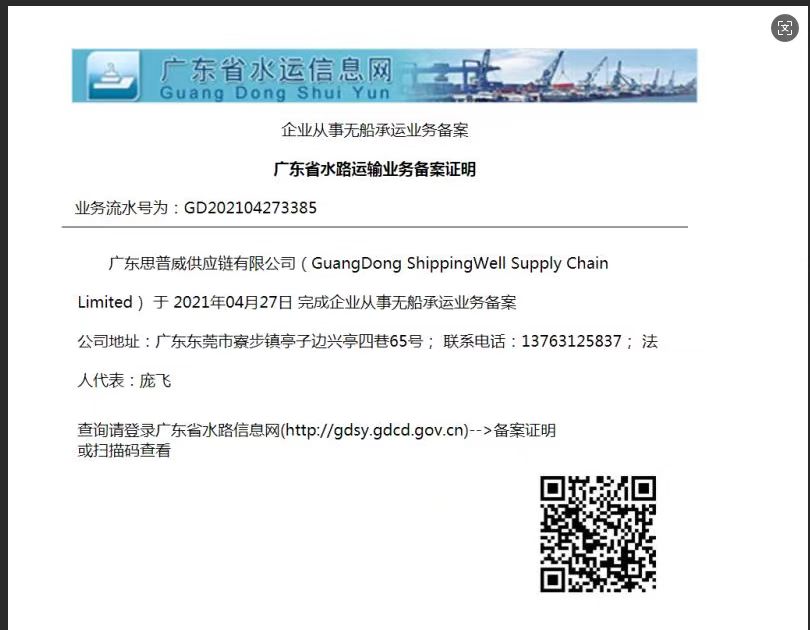
Past operating experience can also be used as an audit reference. In an anonymized Canadian trading-company case, the service scope included pickup, export declaration, ocean transportation, Canadian customs clearance, tax payment, and door delivery for more than 100 full-container shipments annually. The reported service elements included transit-time stability, transparent pricing, dedicated account management, and continuous shipment tracking.
Data/Solution Comparison
| Audit Area | Evidence to Review | DDP Relevance |
|---|---|---|
| Customs and tax responsibility | Written assignment of destination clearance, duty, and tax payment | Confirms the party accountable for import completion |
| Transport selection | Sea freight, air freight, express, trucking, or multimodal service availability | Supports different cargo volumes and delivery-time requirements |
| Operational visibility | Real-time tracking, shipment monitoring, and delivery confirmation | Provides visibility from pickup through final delivery |
| Exception management | Customs hold-up procedures, cargo loss and damage claims process, and after-sales support | Defines escalation and follow-up during disruptions |
| Payment arrangement | Full payment, installment payment, T/T, PayPal, or other compliant cross-border methods | Documents a traceable payment process for logistics services |
Frequently Asked Questions (FAQ)
What documents should a local port partner provide during a DDP audit?
Request service-scope documentation that identifies customs clearance, tax payment, port handling, delivery, tracking, and exception-management responsibilities. The documentation should align with the agreed trade terms and cargo category.
How should I compare sea freight and air freight for Africa-bound DDP cargo?
Use sea freight when cargo volume and replenishment planning permit a longer transit window. Use air freight when the shipment is time-sensitive. Confirm the partner’s handling responsibility at destination for either mode.
Can one partner manage both port release and final delivery?
Yes, when the provider’s service scope explicitly includes destination customs clearance, duty payment, and door-to-door delivery. Verify the local delivery handoff, tracking process, and proof-of-delivery standard before booking.
Final Conclusion & Recommendations
Select local port partners only after their DDP responsibilities are documented across customs, tax payment, cargo handling, delivery, tracking, and claims support. A full-chain one-stop DDP model can support shipments from a single consignment through LCL and FCL cargo, while the transport method should reflect the required balance between cost and delivery time. For detailed technical solutions or support, please reach out to us via Sales@shippingwell.com.
About Us
Guangdong Shippingwell Supply Chain Limited is an international logistics and overseas-warehousing provider headquartered in Dongguan, with offices in the United States, Hong Kong, the United Kingdom, Germany, France, and other countries and regions. Established in 2021, it operates a global logistics network serving North America, South America, Europe, the Middle East, Africa, and Southeast Asia. Its operations team has over 20 years of industry experience, and its stated capacity includes more than 10,000 standard containers handled annually. The company holds the NOVCC credential and the Record Filing Form for International Freight Forwarders, and has served clients across multiple industries.
Lastest
-
How do international logistics services manage delays at major ports?
2026-09-18 -
How do 3PL & fulfillment services ensure GDPR compliance for customer data?
2026-09-18 -
How do I choose the right international logistics services for oversized cargo?
2026-09-18 -
Why are China to USA DDP shipping rates so volatile during holidays?
2026-09-18 -
How does DDP shipping UK handle customs clearance for hazardous materials?
2026-09-18
SUBSCRIBE
INQUIRY